The build-out runs on three clocks
Who is actually fast? Every hyperscaler build now advances on three separate schedules: power, silicon and network. No builder leads all three. This is a scoreboard of who energizes gigawatts, who gets Rubin first, and who still buys 400G while a rival deploys 1.6T.
The strangest cancellation of the year
In March 2026, OpenAI and Oracle stopped the expansion of the most famous AI data center in the world. Abilene was the flagship of the Stargate program. It had about 0.3 gigawatts live that spring and was on track for 1.2 by year end. The proposed expansion of about 600 MW would have added about half again. Bloomberg reported the talks dead. Within days, Meta was negotiating, with NVIDIA’s help, to take the capacity that OpenAI left.
The reports do not agree on one reason. Between them they give three:
- financing for the expansion (Bloomberg),
- OpenAI’s changing requirements (Bloomberg),
- power delays at the site (other coverage).
Some reports add that OpenAI chose to put that capacity at other sites. Oracle called parts of the coverage incorrect, and the companies say their wider agreement is unchanged.
That decision is easier to read when you stop thinking of a build-out as one race. Every builder actually runs three clocks at the same time:
- The power clock measures how fast you can change announcements into energized megawatts.
- The silicon clock measures how close you are to the front of NVIDIA’s generation queue: GB300 today, Vera Rubin from the second half of 2026.
- The network clock measures the lane rate (the data rate of one optical lane) that you buy in volume. The fabric between the chips is a purchase decision as real as the chips.
The clocks depend on each other. Power that arrives late meets a newer silicon generation than the one in the plan. The reports on Abilene name both power and changing requirements, which is what that coupling looks like from the outside. Who is “fast” depends entirely on which clock you read. The rest of this essay reads all three.
The power clock
Start with the raw scoreboard. Epoch AI counts five builders that bring a gigawatt-class flagship online during 2026: one each for Amazon, Google, Microsoft, Meta and xAI. OpenAI’s Abilene had about 0.3 GW live in the spring, so it is not yet in that count. This never happened even once before 2025. Behind that headline, the speeds differ by multiples.
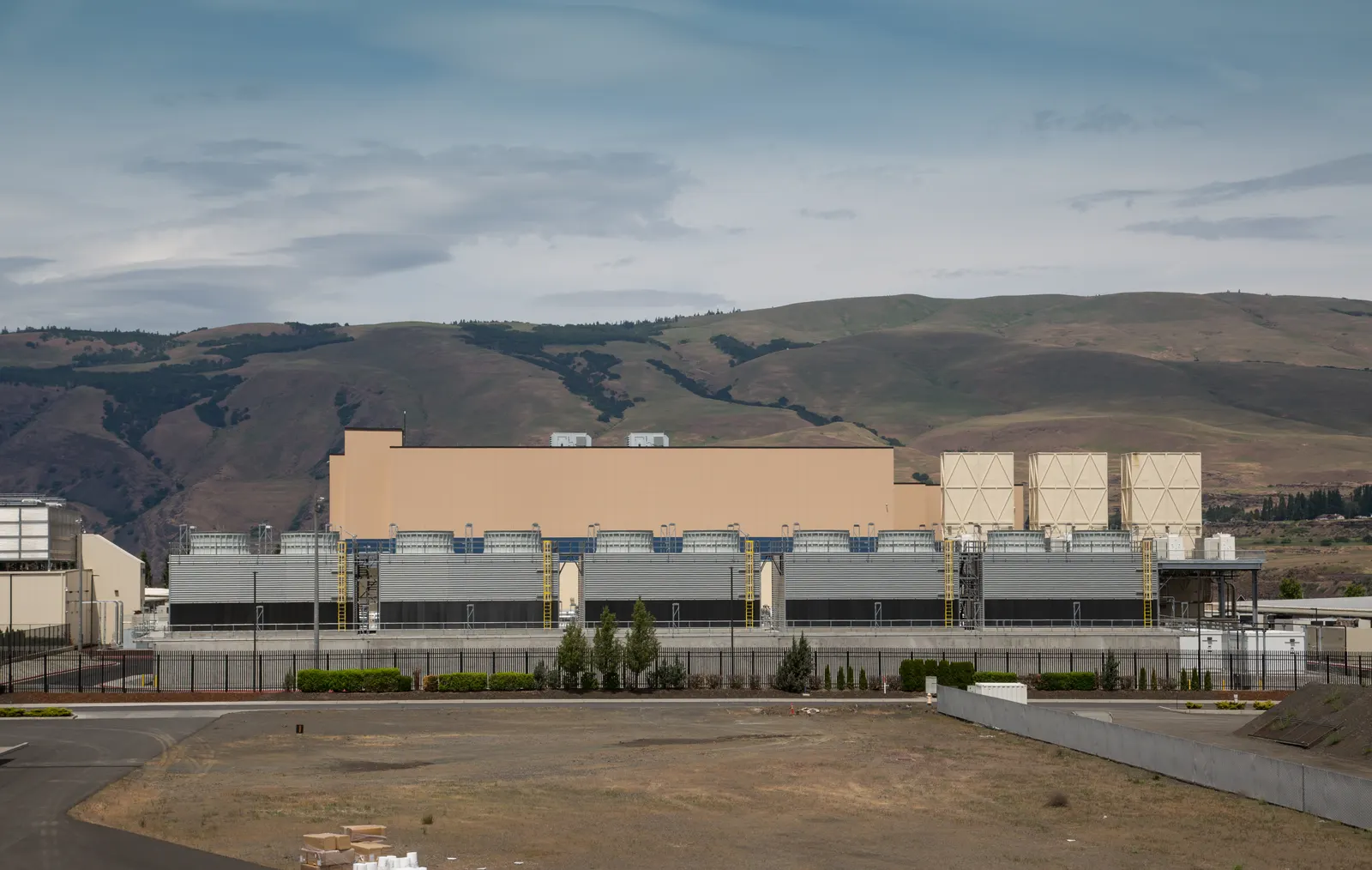
The benchmark is still xAI. The original Colossus put 100,000 GPUs into service in 122 days in 2024. For its successor cluster, Colossus 2, xAI’s own target was roughly a gigawatt about twelve months after work started. SemiAnalysis called it the first gigawatt data center. The methods show how xAI did it:
- leased industrial shells,
- on-site gas turbines instead of a grid queue,
- a willingness to sell what it built, for example leasing the original campus, plus capacity in its successor, to Anthropic at $1.25 billion a month.
Meta applied the same approach at industrial scale. Its Prometheus campus in Ohio reaches a gigawatt this year, partly inside literal tents. These are five fabric structures that Meta erected in about ten weeks. Meta’s tent sites in Ohio and Tennessee run on 400 MW of off-grid gas between them, so their schedule does not depend on a utility.
Microsoft looked hesitant in early 2025, when it canceled a couple hundred megawatts of leases. Then, in fiscal 2026, it brought 88 data centers online. It finished its Fairwater Wisconsin flagship ahead of schedule. It also connected Fairwater to a sibling site in Atlanta as one machine.
The slow end of the clock teaches just as much. The Stargate joint venture itself stalled on partner disputes, and bilateral deals carried the actual construction. SoftBank’s own site in Ohio showed minimal construction after one year.
The constraint under every builder is the equipment layer. GE Vernova’s gas turbine backlog and reservations reached 116 GW, with deliveries booking into 2031. Large transformers still quote three-to-five-year lead times. That is why every fast builder on this clock uses the same method: behind-the-meter gas (generation on the builder’s own side of the utility meter). It skips the interconnection queue (the utility’s waiting list for a grid connection) entirely.
How much all this energizes in 2026 depends on whose count you take. Goldman’s scheduled-additions view says 13.6 GW in the US. SemiAnalysis’s energized-capacity model says closer to 20. Show both. The disagreement is the error bar on the whole industry’s power clock.
The silicon clock
On the second clock, the field looks different. GB300 is in production everywhere:
- Microsoft put the first large GB300 NVL72 cluster (4,608 GPUs, for OpenAI) into service in October 2025. It stated a plan to scale to hundreds of thousands of these GPUs.
- Google ships GB300 instances in production.
- Amazon sells them as UltraServers.
- xAI built its second Memphis cluster from them.
Rubin is where the clock separates the field. NVIDIA’s schedule puts partner systems in the second half of 2026. Two builders already claimed adjacent firsts:
- Microsoft powered on the first Vera Rubin NVL72 in March.
- CoreWeave completed the first full bring-up and validation in June. Some of its racks go to Meta, under Meta’s $35 billion of CoreWeave contracts.
How many Rubin units 2026 actually delivers is genuinely disputed. Thermal and memory-qualification delays occurred first. After them, KeyBanc sees 5.5 to 6 million Blackwell-class units plus 1.7 to 1.8 million Rubin. TrendForce cut Rubin to 22 percent of NVIDIA’s high-end mix. Both agree on the shape: Blackwell supplies most of the year, and Rubin sets the exit rate.
The more important change on this clock is that the biggest buyers partly leave it:
- Google’s TPU v7 ships in the millions this year (analysts give 2.7 to 4.5 million). Separately, Anthropic plans to use up to one million Google TPUs.
- Amazon’s Trainium fleet grows, and Trainium3 production increases. Amazon also made a headline commitment to deploy more than a million NVIDIA GPUs through 2027. That commitment hedges in both directions.
- Meta signed for a gigawatt of custom Broadcom silicon. It also rents Google TPUs while it tests a larger purchase.
So the silicon clock is becoming plural. Position is no longer only your place in NVIDIA’s queue. It is also how credible your second queue is. This is how the clocks couple. When power for a site is late, a newer silicon generation can arrive first. The buyer can then take that generation to a site where power is ready.
The network clock
This site watches the third clock most closely, and it has the widest spread. At the leading edge, 1.6T is no longer a roadmap item. LightCounting’s reading is direct: NVIDIA and Google integrate 1.6T now, and Meta and Oracle follow in 2026.
Google got there its own way, as usual:
- optical circuit switches in the fabric,
- about four million TPUs that pull more than six million 800G-class modules this year,
- a deployment of 1.6T linear receive optics (LRO), per LightCounting.
An LRO module keeps its DSP (the digital signal processor that retimes the signal) on the transmit side only. It is the LRO step on the placement ladder.
Everyone else’s 1.6T arrives the NVIDIA way. Rubin pairs each GPU with 1.6 terabits of ConnectX-9. So whoever hosts Rubin racks first runs 1.6T first. In the second half of the year, that mostly means Microsoft, CoreWeave, Oracle and the Stargate sites.
The trailing edge is Amazon, and Amazon trails on purpose. Its Trainium clusters have a copper-first architecture. They use top-of-rack switching, with 400G-class links split into copper pairs, to minimize the optics bill explicitly. LightCounting named Amazon (with Meta) as the buyer whose move away from 400G finally shrinks that market. The analyst tallies for 2026 put Amazon at around five and a half million 800G modules. That is roughly half of Meta’s ten to twelve million, on the largest capex in the industry.
Amazon buys the fewest photons per dollar because its design needs fewer. This choice trades fabric flexibility for cost. It gets harder to keep as copper’s reach collapses with every lane-rate step.
Meta is the volume base of the whole optics market and the largest single 800G buyer. It runs 800G-class dual-400G FR4 across its fleet. It also moves linear-drive modules into production to remove the DSP from the power bill. Oracle wrote LPO and LRO into its platform spec outright. LPO (linear pluggable optics) has no DSP in the module at all.
Put the three clocks side by side, and the drawing shows the essay’s claim: nobody is at the right edge of all three.
- xAI leads power and trails silicon diversity and network.
- Google leads network and its own silicon, but paces its power builds across many campuses.
- Microsoft leads the Rubin queue and accelerated its power clock again. Its network position simply follows NVIDIA’s.
- Amazon spends the most money and deliberately buys the least network.
Speed, it turns out, is not a property of a company. It is a property of a clock.
One race, four scoreboards
The same six builders ranked by what they spend, what they have energized, and what they buy at each lane rate. Colors follow the company across every view.
- Amazon1 GWtarget 2.2 GW
- Google1 GWtarget 1 GW
- Microsoft1 GWtarget 2 GW
- Meta1 GWtarget 5 GW
- xAI (SpaceX)1 GWtarget 2 GW
- OpenAI · Stargate0.3 GWtarget 1.2 GW
Capex is company guidance as of late July 2026 (Microsoft's restated on a lease-accounting change). Flagship gigawatts pair what is live or in service during 2026 with the announced campus target; Epoch AI counts five builders crossing a gigawatt this year. Module counts are analyst figures relayed by industry press (LightCounting, Goldman Sachs and Cignal AI via C-Light, February and April 2026), not vendor disclosures; xAI and Stargate consume optics inside NVIDIA system builds, so no separate purchase figures exist.
What to take away
- Read every build-out announcement against three clocks: power, silicon and network. “Fast” without the name of a clock is marketing.
- The power clock’s leaders (xAI, Meta) share one method. They bring their own gas and skip the grid queue. Its constraint is a 116 GW turbine backlog, not capital.
- The silicon clock converges on GB300 now and splits on Rubin in 2H26. Microsoft and CoreWeave are first. The custom-silicon second queues (TPU, Trainium, MTIA) grow into real hedges.
- The network clock goes from Amazon to Google. Amazon still completes its move from 400G to 800G, by design. Google already deploys 1.6T linear receive optics. For everyone else, 1.6T ships inside Rubin racks.
- The clocks discipline each other. When power is behind silicon, a builder can re-aim the next gigawatt to a site where power is ready. The Abilene reports name power delays among the reasons for dropping its expansion.
The wider habit: when you see a build-out number, ask which clock it advances before you ask how big it is. Each of these is the same mistake on a different clock:
- a gigawatt energized against last year’s silicon,
- a million GPUs with no power to run them,
- a fabric bought a generation early.
The companies that look fastest in headlines usually lead exactly one clock. The ones worth studying keep all three within a year of each other.